Unifeed Mixers And Knives: The Winning Combo For The Perfect Feed Ration
- lunedì 27 febbraio 2023

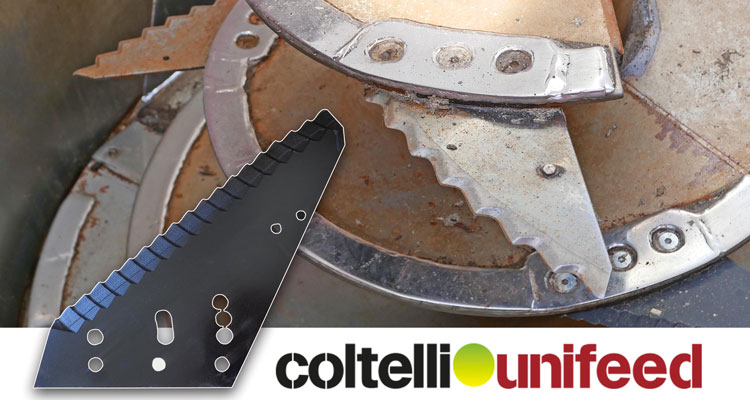
This topic came to my mind a few days ago when I was gifted some truly fantastic Parma ham. The kind you slice by hand, with a proper knife, to get those tasty, perfectly shaped slices that bring out all the flavor and aroma of this delicacy.
But what happens if you don’t have the right knife?
How often do we see our incredible food specialties — and we have plenty of them in our country! — not being fully appreciated due to improper slicing or cutting? Professional chefs know very well that every food item requires the proper knife, as cutting techniques and methods vary depending on the type of product.
The small knife, the chef's knife, the smooth-blade knife, the serrated knife, the skinning knife, or the butcher’s knife — each serves a different purpose. For us "common users," they all just go by the name “knife.”
I often get asked, “Why isn’t the mixer working properly?”
And the follow-up question is always the same: “What should I do?”
That’s where a key component of the feed mixer wagon comes into play — one that is often overlooked due to its hidden position, but which plays a crucial role in the quality of the unifeed ration: the knives mounted on the mixing auger.
Even the most high-performance mixer can deliver poor results and produce uneven feed if the knives on the milling head and augers are not doing their job properly.
Cattle feeding relies on a diet rich in grains and forages, making up about 85% of the total ration. The optimal ration results from the right proportion of different ingredients — grass, forage, grains, oilcakes — properly mixed and prepared without compromising their nutritional and organoleptic properties.
For example, forages and hay — composed of fibers of varying lengths — are key to improving productive performance, animal health, and overall well-being. Each forage type is characterized by its nutritional composition, including fiber, sugars, proteins, and minor but essential elements like minerals and vitamins.
However, it's essential that the fibers from the hay within the unifeed ration maintain a precise length (about 2.5 to 3 cm) to properly stimulate the rumen, while preserving their taste and nutritional qualities, making them palatable and appetizing for the animals.
What happens if the feed is poorly mixed because the auger knives are worn out or ineffective?
It’s simple: the unifeed ration will not be homogeneous, the fibrous ingredients may be shredded beyond recognition and lose their flavor, and the animals will not ingest the right amount of balanced feed for their proper sustenance.
The effects will be clearly noticeable: both the quantity and quality of milk production and the animal's health will suffer.
That’s exactly why we created bladesunifeed.com, the specialized portal dedicated to knives and blades for unifeed mixer wagons.
On this platform, professional livestock farmers will find answers to all their questions, along with specific knives compatible with all brands of mixer wagons available on the market and widely used in Italian farms.
What’s more, the selection of blades — the result of years of experience in the livestock industry — is not only complete but also highly accurate, ensuring top quality and proper treatment of the materials used to manufacture each knife.
The right knife makes all the difference: at bladesunifeed.com, you will find the most comprehensive and specialized selection of blades for all types of feed mixers.
And not just knives — but also consulting services and technical support to help you make the most of your unifeed mixer, whatever the type or model.